The SRE AI Agents Revolution: Transforming Production Operations
Autonomous SRE AI Agents are revolutionizing how organizations manage and maintain production systems, delivering unprecedented reliability and performance while reducing operational costs.
What Are SRE AI Agents?
SRE AI Agents are autonomous artificial intelligence systems specifically designed to handle the complete lifecycle monitoring and remediation of production services. Unlike traditional monitoring tools or basic automation, these agents combine advanced machine learning, natural language processing, and domain-specific knowledge to understand, analyze, diagnose, and resolve complex production issues without human intervention.
"SRE AI Agents represent the evolution of Site Reliability Engineering from a human-centric discipline to an AI-augmented and eventually AI-autonomous function."
The core capabilities of SRE AI Agents include:
1. Comprehensive Monitoring
SRE AI Agents continuously monitor logs, metrics, traces, and system health across your entire production environment. They maintain a real-time understanding of system behavior, detecting both obvious issues and subtle anomalies that might indicate emerging problems. This monitoring extends beyond simple threshold-based alerts to include complex pattern recognition and contextual awareness.
2. Autonomous Diagnosis
When anomalies are detected, SRE AI Agents autonomously investigate the root causes using sophisticated diagnostic algorithms. They analyze relationships between services, examine historical patterns, and understand the context of the issue. This goes far beyond traditional root cause analysis, as the agents can correlate seemingly unrelated events across distributed systems.
3. Automated Remediation
Perhaps the most revolutionary aspect of SRE AI Agents is their ability to automatically implement fixes. Once a diagnosis is complete, agents can execute pre-approved remediation actions such as restarting services, scaling resources, rolling back deployments, or implementing configuration changes. For more complex issues, they can propose solutions to human operators with detailed explanations.
4. Continuous Learning
Unlike static automation tools, SRE AI Agents learn from every incident they handle. This continuous learning allows them to become more effective over time, recognizing patterns more quickly, diagnosing more accurately, and implementing more successful remediation strategies. The result is a constantly improving system that gets more valuable with each day of operation.
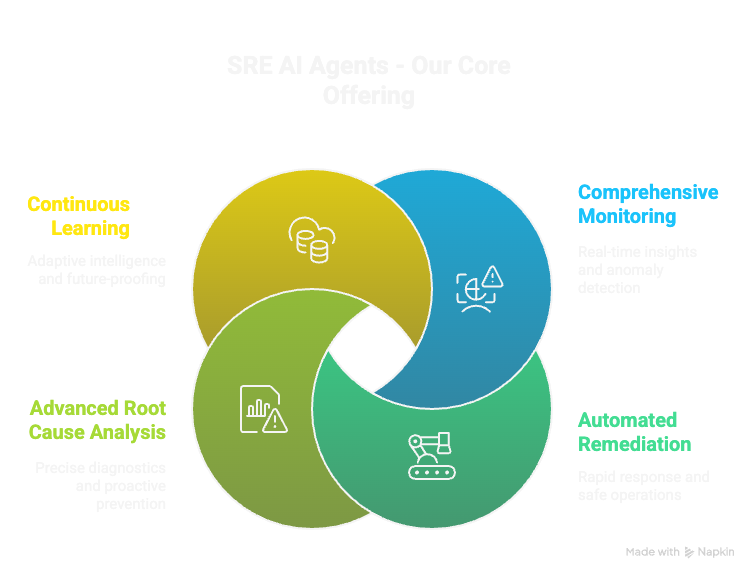
Figure 1: SRE AI Agent architecture showing monitoring, diagnosis, remediation, and learning components
Real-World Impact: The Business Case for SRE AI Agents
Organizations implementing SRE AI Agents have reported remarkable improvements in their production operations:
Reduced MTTR (Mean Time to Remediation)
Our customers have seen up to a 78% reduction in MTTR, with many issues resolved in seconds rather than minutes or hours. This dramatic improvement comes from eliminating the delays inherent in human-based incident response: alert fatigue, context gathering, diagnostic time, and human decision-making.
Improved System Reliability
With faster remediation and proactive issue identification, SRE AI Agents help achieve "five nines" (99.999%) or better availability. This translates to just minutes of downtime per year rather than hours, protecting revenue and reputation.
Cost Reduction
The operational cost savings from SRE AI Agents come from multiple sources:
- Reduced need for 24/7 on-call rotation and emergency response
- Lower downtime costs and SLA violation penalties
- More efficient resource utilization through predictive scaling
- Fewer production incidents requiring extensive postmortems
Engineering Focus on Innovation
Perhaps the most significant benefit is freeing your engineering talent from repetitive operational tasks. With SRE AI Agents handling routine monitoring and remediation, engineers can focus on innovation, feature development, and architectural improvements that drive business value.
SRE AI Agents vs. Traditional Monitoring Solutions
| Capability | Traditional Monitoring | Basic Automation | SRE AI Agents |
|---|---|---|---|
| Issue Detection | Threshold-based alerts | Rule-based detection | ML-powered anomaly detection with context awareness |
| Diagnosis | Manual by humans | Limited predefined paths | Autonomous root cause analysis with learning capabilities |
| Remediation | Manual by humans | Simple predefined actions | Intelligent remediation with multiple strategies |
| Learning | None | None or minimal | Continuous improvement from each incident |
| Adaptability | Low | Medium | High - adapts to changing environments |
Implementation Journey: Adopting SRE AI Agents
The journey to fully autonomous SRE AI Agents typically follows a phased approach:
Phase 1: Enhanced Monitoring
Implementation begins with deploying advanced monitoring capabilities across your production environment. SRE AI Agents learn normal system behavior and begin identifying anomalies, but remediation remains manual.
Phase 2: Assisted Remediation
As confidence grows, SRE AI Agents begin suggesting remediation actions to human operators, providing detailed explanations and predicted outcomes. This builds trust while the system continues to learn.
Phase 3: Selective Autonomy
For well-understood issues with clear remediation paths, SRE AI Agents begin taking autonomous action, with careful logging and the ability for human override. Typically, organizations start with non-critical systems.
Phase 4: Full Autonomy
As the system proves its reliability, the scope of autonomous operations expands to cover more complex scenarios and critical systems, always maintaining appropriate safeguards and transparency.
The Future of SRE AI Agents
The evolution of SRE AI Agents is continuing at a rapid pace, with several exciting developments on the horizon:
Cross-System Learning
Future SRE AI Agents will share knowledge across organizations (while maintaining privacy and security), allowing them to recognize and remediate issues they've never encountered in your specific environment.
Predictive Operations
Advanced forecasting capabilities will allow SRE AI Agents to predict and prevent issues hours or days before they would occur, moving beyond reactive remediation to proactive optimization.
Natural Language Interfaces
Engineers will interact with SRE AI Agents through natural language, asking complex questions about system behavior or requesting specific operational changes without needing specialized query languages.
Conclusion: The Time for SRE AI Agents Is Now
As production systems grow increasingly complex and distributed, traditional approaches to site reliability engineering are reaching their limits. Human operators simply cannot process the volume of telemetry data generated by modern systems quickly enough to maintain optimal performance.
SRE AI Agents represent a fundamental shift in how we approach production operations—from reactive human response to proactive AI-driven management. Organizations that embrace this transformation gain not just improved reliability and reduced costs, but a competitive advantage in their ability to rapidly deploy and maintain complex systems.
The SRE AI Agents revolution is already underway. The question is not whether AI will transform production operations, but when your organization will begin reaping the benefits.
Ready to experience the SRE AI Agents difference?
Contact AgentiqOps.ai today for a personalized demonstration of our SRE AI Agent platform and discover how we can transform your production operations.
Request a Demo